You may wonder what it means when you learn that your newborn baby has a positive direct coombs.
Well, the purpose of the direct coombs test (DAT) is to determine if there are antibodies attached to patient red cells. In the case of newborn babies these antibodies would be antibodies from the mother. This situation is called Hemolytic Disease of the Newborn (HDN) and it's dangerous for the baby because the antibodies break down the baby red cells, causing an increase in bilirubin. Elevated bilirubin levels in babies can cause brain damage and death if not monitored.
This can occur when the baby's blood type is incompatible with the mother's. For example if the mother is type O, her natural Anti-A,B antibodies could attach to the baby's red cells if baby is type A.
A more severe case is when the mother has an allo-antibody against a red cell antigen her baby has on its red cells.
More babies used to die due to HDN but Rhogam and intrauterine transfusion help to reduce the severity of the situation.
Here is how we actually perform the direct coombs (DAT) in the blood bank.
1. We create a suspension of saline and baby red cells and wash a drop of it in a test tube.
2. Next we add Anti-IgG to the remaining red cells and centrifuge the tube. If there is (mom) antibody attached to the baby red cells, the Anti-IgG will attach to these (mom) antibodies, causing the red cells to clump (agglutinate). This would indicate a positive direct coombs test.
3. We then would do a separate elution procedure to concentrate the attached (mom) antibody and identify it.
Showing posts with label blood bank. Show all posts
Saturday, September 1, 2012
ABO Blood Types Explained
What are the Common Blood Types?
There are 8 blood types: O Positive, O Negative, A Positive, A Negative, B Positive, B Negative, AB Positive and AB Negative.
Type A people have the A antigen on their red cells
Type B people have B antigen on their red cells
Type AB people have A and B antigen on their red cells
Type O people have neither antigen on their red cells
The positive and negative titles represent the presence or absence of the RH-factor.
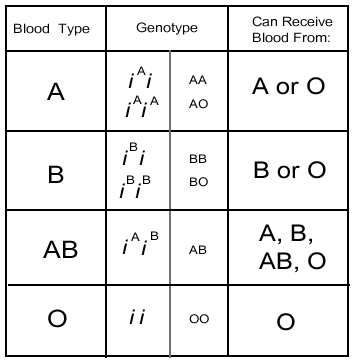
Blood types are genetic and each person receives one copy of their blood type gene from each parent. A and B are always dominant over O. A and B are codominant when both are present. Therefore if someone inherits an A gene from one parent and a (blank) O from the other, he will be type A. However if he inherits an A gene from one parent and a B gene from the other, he will be type AB.
Because blood types are hereditary, they can be used to exclude (but not include) someone as father in cases of paternity. If two parents are blood type O, they can only produce children who are also type O. If just one parent is AB, the child will be either A,B or AB--it would be impossible for the child to be type O.
When we do a blood type, we type the red blood cells with Anti-A, Anti-B and Anti-D (RH). Agglutination with these anti-sera indicates the presence of the appropriate antigen. For example, if there is agglutination when red cells are mixed with Anti-A antisera, but none when these same red cells are combined with Anti-B and Anti-D this means that the patient is type A Negative. We call the typing of the red cells in this way the "forward" or "front" type.
People create naturally occurring antibodies to foreign blood types around 6 months of age.
Type A people naturally form Anti-B.
Type B people naturally form Anti-A.
Type O people naturally form Anti-A and Anti-B, actually Anti-A,B
We also do what's called a "reverse" or "back" type. As a confirmatory measure, we take a couple drops of patient plasma and test them against known A and B cells. If a person is type B, his plasma should agglutinate known A cells (due to his natural Anti-A), but not the B cells.
The presence of these naturally occurring ABO antibodies is the reason why everyone can't receive blood from any random person. A person transfused with blood of an incompatible type would have a severe hemolytic transfusion reaction could die within moments.
Here is a compatibility chart illustrating which blood types can donate and accept from others.
As you can see Type O Negative is the universal donor and can donate to anyone and Type AB Pos is the universal acceptor and can receive blood from any type.
Only blood bankers and some nurses/doctors would know that this chart isn't completely accurate. Although we try to give RH-negative patients only RH-negative blood, sometimes we do not in the interest of our blood inventory. Therefore sometimes an O-negative patient will receive several units of O-Positive red cells. The only time we would absolutely not do this is when it is known that the patient has Anti-D (an antibody to the RH factor) and we try not to do this with RH-negative women of childbearing age because we do not want to stimulate them to develop Anti-D which could later affect any RH positive children they may carry.
There are 8 blood types: O Positive, O Negative, A Positive, A Negative, B Positive, B Negative, AB Positive and AB Negative.
Type A people have the A antigen on their red cells
Type B people have B antigen on their red cells
Type AB people have A and B antigen on their red cells
Type O people have neither antigen on their red cells
The positive and negative titles represent the presence or absence of the RH-factor.
Blood types are genetic and each person receives one copy of their blood type gene from each parent. A and B are always dominant over O. A and B are codominant when both are present. Therefore if someone inherits an A gene from one parent and a (blank) O from the other, he will be type A. However if he inherits an A gene from one parent and a B gene from the other, he will be type AB.
Because blood types are hereditary, they can be used to exclude (but not include) someone as father in cases of paternity. If two parents are blood type O, they can only produce children who are also type O. If just one parent is AB, the child will be either A,B or AB--it would be impossible for the child to be type O.
When we do a blood type, we type the red blood cells with Anti-A, Anti-B and Anti-D (RH). Agglutination with these anti-sera indicates the presence of the appropriate antigen. For example, if there is agglutination when red cells are mixed with Anti-A antisera, but none when these same red cells are combined with Anti-B and Anti-D this means that the patient is type A Negative. We call the typing of the red cells in this way the "forward" or "front" type.
People create naturally occurring antibodies to foreign blood types around 6 months of age.
Type A people naturally form Anti-B.
Type B people naturally form Anti-A.
Type O people naturally form Anti-A and Anti-B, actually Anti-A,B
We also do what's called a "reverse" or "back" type. As a confirmatory measure, we take a couple drops of patient plasma and test them against known A and B cells. If a person is type B, his plasma should agglutinate known A cells (due to his natural Anti-A), but not the B cells.
The presence of these naturally occurring ABO antibodies is the reason why everyone can't receive blood from any random person. A person transfused with blood of an incompatible type would have a severe hemolytic transfusion reaction could die within moments.
Here is a compatibility chart illustrating which blood types can donate and accept from others.
As you can see Type O Negative is the universal donor and can donate to anyone and Type AB Pos is the universal acceptor and can receive blood from any type.
Only blood bankers and some nurses/doctors would know that this chart isn't completely accurate. Although we try to give RH-negative patients only RH-negative blood, sometimes we do not in the interest of our blood inventory. Therefore sometimes an O-negative patient will receive several units of O-Positive red cells. The only time we would absolutely not do this is when it is known that the patient has Anti-D (an antibody to the RH factor) and we try not to do this with RH-negative women of childbearing age because we do not want to stimulate them to develop Anti-D which could later affect any RH positive children they may carry.
What is the Blood Bank?
I work in the blood bank (lab) at a large hospital.
Although many may not be aware of the blood bank's presence in the hospital, our department plays an important role in patient care and when a patient needs a blood transfusion its our careful expertise that ensures that the safest blood products are dispensed.
Who Works in the Blood Bank?
Let's start with the people working in the blood bank. The blood bank (along with most of the lab personnel of other departments) consists of either Medical Technologists or Medical Laboratory Technicians.
Medical Technologists (MT) have a 4-year bachelors degree in science and an extra year of medical technology school under their belt. Some universities offer a 3+1 inclusive Medical Technology bachelors degree.
Medical Laboratory Technicians (MLT)have an associates degree from a 2-year program offered through community colleges.
Both positions are accredited through the ASCP and as expected the MLTs have a lower pay scale than the MTs (but not by all that much).
In our hospital the lab is departmentalized and only MTs are allowed to do the benchwork in the blood bank. But in smaller hospitals MLTs do work in blood bank along with the other areas.
What Does the Blood Bank Do, Exactly?
The main job of the blood bank is to crossmatch red blood cells and choose the appropriate blood components (platelets and plasma) for our patients.
Nurses and CNAs are constantly at our window picking up blood for their patients. Those who are anemic due to surgery, disease, malnutrition, etc...need blood to raise their hemoglobin level. We also have operating room emergencies and trauma patients (car crashes, gunshots, stabbings) that require blood products to quickly replace the volume they are losing. These emergency situations can be very chaotic and frantic, but I also find it kind of exciting.
Sometimes patients who have been pregnant or transfused in the past develop antibodies to certain red cell antigens. This means that if they are transfused with blood containing the antigen they have an antibody against, they may have a transfusion reaction.
We spend hours of various testing to identify what antibody or antibodies are present in such a patient. Then we spend a couple more hours to test blood units for the corresponding antigen. We would give the patient blood that is negative for the offending antigen. Our blood bank screens incoming type O donor blood for common antigens throughout the week so that we can have access to antigen negative blood quickly, but it's impossible to predict exactly what and how many we'll need.
All cord blood blood comes to our blood bank. We have to determine the blood type and run a direct coombs on them. This is important because when RH+ babies are born to RH- mothers, the mother must be given a shot of RH immunoglobulin to prevent her from developing the RH antibody that could affect any future RH+ babies she carries.
The direct coombs is a test to see if the baby has the mother's antibodies on its red cells. A positive result could be due to the mother's natural ABO antibodies attacking baby red cells of a different type. OR the mother may have a red cell antibody (like the RH antibody mentioned) against an antigen on the baby's red cells--this is usually more severe than a mother-baby ABO incompatibility. In either case, the antibodies cause the baby red cells to hemolyze, resulting in an increased bilirubin level in their little bodies. High bilirubin in babies can cause brain damage and death.
Those are the major duties of the blood bank but there are many miscellaneous tasks that fill our work day, like unpacking donor blood from our suppliers, thawing out plasma, pulling off blood syringes for our babies, titering prenatal antibodies, washing and irradiating blood for those who require it, testing units for sickle cell, and the list goes on.
Where Does the Blood Come From? Can I Donate Blood at the Blood Bank?
In our blood bank we do not draw blood donations. Our hospital occasionally has blood drives sponsored by our suppliers but one would not be able to come to the hospital blood bank to donate blood. All of our blood products come from blood donation centers like the American Red Cross and its competitors.
Subscribe to:
Comments (Atom)